
When Image Becomes More Important Than Flavour
- Vassilis Alexiou
- May 11
- 5 min read
“For nearly a decade now, I have noticed more and more people remembering how a dish looked, rather than how it tasted.”

Let me share something that many in our field have learned the hard way: an image without flavour is a promise that remains unfulfilled. This might be one of the most fundamental contradictions in today’s food culture.
We live in an age where the image has acquired immense power—not only in food, but in almost every form of cultural expression. This trajectory began when architecture gradually sacrificed durability for spectacle, as clearly articulated in the seminal work Learning from Las Vegas by Robert Venturi and Denise Scott Brown. It was there that the building stopped being understood as a space that embraces you, and became instead a decorated shed—an object designed primarily to communicate an image.
Similarly, music increasingly surrendered to MTV aesthetics, reducing composition to a secondary role in the service of visual identity. Frank Zappa and not only him warned against this shift, describing an industry increasingly governed by marketing logic and the pursuit of perfect packaging.
The Tyranny of the Pixel

“The image is not the problem. The absence of truth behind it is.”
This dominance of appearance has inevitably permeated gastronomy. In molecular gastronomy, technique sometimes becomes an end in itself. In parallel, the wine world has increasingly shifted toward products designed to deliver immediate visual and sensory impact.
Designed:— for a dish that will be photographed, — for a wine that will instantly impress the critic,— for an experience that performs perfectly on screen, but not necessarily in memory.
Over the past years, through countless pairings, tastings, and shared meals, one observation has become increasingly clear: people rarely return for the image. They return for the one flavour that remains embedded in memory.
“The aesthetics of a dish are proof that man seeks something beyond survival.”
Imagery in gastronomy is not, in itself, the problem. On the contrary, it is proof that eating has evolved from a biological necessity into a cultural ritual. The issue emerges only when the image no longer supports the flavour, but replaces it.
The Architecture of Flavour: From Raw Material to Experience
Knowledge begins before the kitchen
“Knowledge of the raw material is not acquired on a screen, but in the soil.”
Discussions about gastronomy often begin with technique. For me, they begin much earlier: with the ability to recognise raw material.
It begins the moment you understand why a traditional Xygalo from a small producer behaves differently on the palate. Why a beetroot grown properly in the soil develops a different density, a different moisture, a different sweetness.
This kind of knowledge is not acquired through social media, nor is it confined to the kitchen. It requires planting, failing, making cheese at home, touching soil instead of stainless steel, and learning through repetition and error. Only then does the difference between mediocre, good, and exceptional become clear.
Technique Must Serve Flavour
“Technique does not exist to impress. It exists to protect
the truth of the material.”
Every decision begins with this principle.
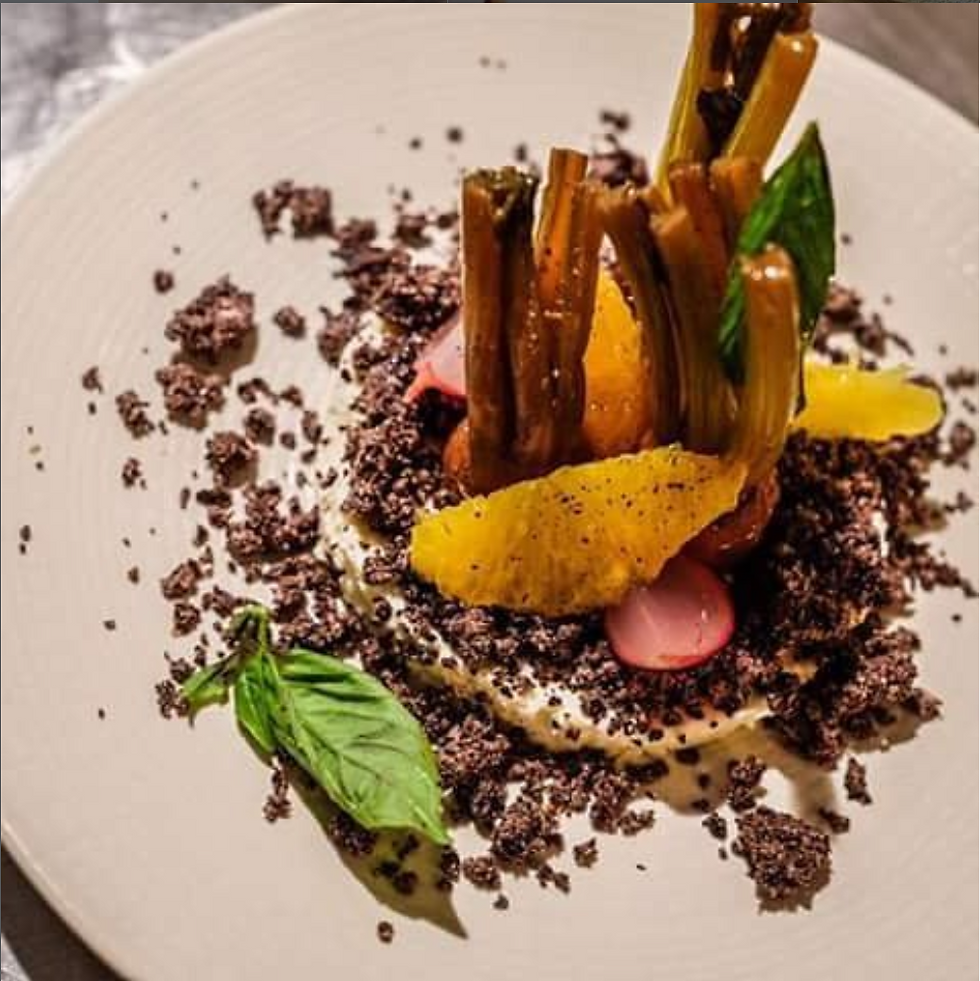
Roasting beetroots in a salt crust, for example, is not an exercise in spectacle. It is a controlled environment where the ingredient cooks in its own juices, preserving structure and minerality.
Had a different expression been desired, a naked roast would have been chosen instead, allowing caramelisation to intensify natural sugars.
On the same plate, the olive follows a traditional path—salt and time—to become edible. Yet its expression is reinterpreted through natural tapioca.
Technically, tapioca starch is transformed through boiling, dehydration, and the incorporation of olive paste into a crisp element. This creates a structural counterpoint to the dish's softer components.
“Technique acquires value only when it serves flavour, memory,
and human perception.”
From a sensory perspective, the tapioca acts as a carrier, softening the intensity of oleuropein and allowing the wine to integrate into the composition rather than clash with it.
The orange element completes the bridge. The careful removal of the membrane is not an aesthetic gesture, but a structural one—removing bitterness that would interfere with clarity and perception.
The result is a dialogue between Xygalo, basil, citrus, and wine—where no element dominates, but all exist in relation.
Yet that relation is never experienced in the same way by everyone.
A diner raised on the bitterness of Mediterranean olive oil, the salinity of island cheeses, and the aromatic memory of basil and citrus will perceive this structure differently from someone shaped by Nordic fermentation, Japanese umami, or Central European acidity.
“The diner is not external to the dish. The diner completes it.”
For this reason, gastronomy cannot be reduced to technique alone. A plate designed for Athens cannot be assumed to exist in the same form in Copenhagen, Tokyo, or New York. Emotional architecture shifts with memory, geography, and cultural conditioning.
The role of technique is not to dominate perception, but to build a bridge between product, culture, and experience.

When Explanations Are Not Required
“When explanations are not required, gastronomy
has achieved its purpose.”
The final measure of success is not narrative complexity, nor explanation at the table. It is the moment when different people experience the same sensation without being told what they are supposed to feel.
At that point, technique has fulfilled its role: it has created a truth that is not explained, but recognised.
Flavour as an Institution Image attracts. Flavour retains.
“Image brings guests. Flavour brings them back.”
It is often said that image brings the first visitor. This is partly true. But after years of service, tastings, and repeated encounters, one conclusion becomes unavoidable: image creates curiosity, but flavour creates return. The first guest photographs and leaves. The second returns. And it is the second who sustains a space, a wine, and an idea.
Viral does not build institutions
“Viral creates noise. Flavour creates repetition.”
A dish without depth is revealed immediately after the photograph. A dish built on structure, technique, and memory does the opposite—it lingers.
The gastronomy of a culture is never preserved through its images. It is preserved through taste transmitted over time.
The technique of image is temporary. The technique of flavour is culture.

AI will replace the image — not the flavour
As we move into an era where artificial intelligence can generate increasingly perfect images, the true value of gastronomy becomes even more defined: what cannot be simulated is memory, texture, and lived experience.
From modern gels and stainless steel tanks to charcoal fire and clay amphorae, every tool serves a single purpose: to express a truth that outlasts its visual representation.
“Flavour is not decoration. It is the architecture of life itself.”
For me, this is not a romantic position. It is a structural one. A decision grounded in longevity rather than visibility.
“Gastronomy is not completed in the kitchen, but in the memory
of the one sitting at the table.”
As always, I would genuinely be interested to hear your thoughts, disagreements, and personal experiences regarding flavour, image, and what ultimately remains after a meal.
Perhaps the true value of gastronomy lies not in digital representation, but in memory.


Comments